
 English
 Français
Oceans Update - June 2026
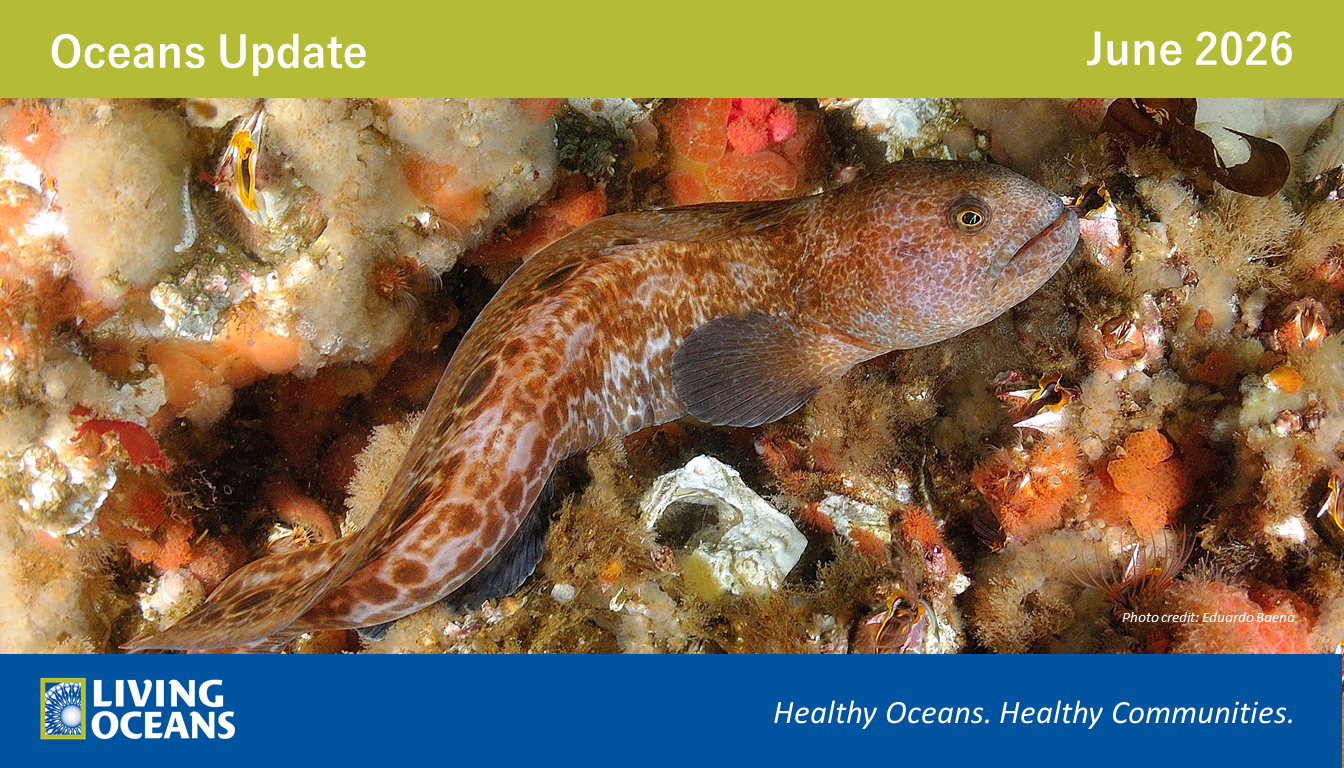
The very first World Oceans Day was declared on June 8, 1992, at the urging of the Canadian delegation to the United Nations Earth Summit in Rio. It didn’t become an official UN day until 2008 and it took some campaigning to have it recognized. Whether we call this the 34th or the 18th anniversary, ocean conservation groups worldwide have celebrated June 8 throughout that time as a day to draw attention to all that the ocean gives us.
In this edition of Oceans Update, we review quite a few ways that attention is being paid to the ocean—some of them more benign than others! Read on and see what I mean.
Once you’ve read all that we’ve been up to and all that we have yet to do to, I hope you’ll take a moment to help us out with our mission, to ensure that Canada’s oceans are sustainably managed and thriving with abundant and diverse sea life that supports vibrant and resilient communities. It’s a big job; we sure could use your help.
With thanks for all that you do,
Karen
May Ottawa visit
Executive Director Karen Wristen travelled to Ottawa in late May with a delegation of colleagues to remind the federal government of the broad support for the salmon farm ban and ask that the Transition Plan be moved forward. Little did we know that the next day, Steven Guilbeault would announce his resignation!

Salmon update June 2026

Sockeye returns to the Fraser River in 2025 were the best for that cycle of salmon since 1987 and the abundance was nearly three times the median prediction. Those salmon were the first to go to sea without having to pass through salmon farm effluent in the Discovery Islands and Broughton. This year is the Adams River run—the dominant run of sockeye that has historically numbered in the tens of millions. Its abundance has been plummeting since 2010: the red line in the graph below traces its descent. What will this year bring?
The Department of Fisheries’ Preliminary Outlook for 2026 is a bit of a mixed bag. Ocean conditions are predicted to be only moderate, with the probable advent of an El Nino, after years of La Nina conditions. El Nino years generally see warmer coastal waters and less food. It’s most likely that temperatures in the river will be higher than ideal and water flow lower. In less-than-ideal conditions, our expectations for recovery of Fraser sockeye abundance are tempered; and it will be difficult to see whether or not the removal of salmon farms has had an influence on overall abundance.
The Outlook examines numerous management units or population groups within the Fraser and two things are striking about these analyses: first, there’s the fact that predictions vary from poor to above-average, unit by unit. Next, and truly infuriating, is the number of management units for which reliable data are not available. Stock assessment has been a priority on paper for DFO for over a decade and even here, in the most closely studied of rivers, we have data deficiencies. Looking at The Outlook for all species, for the whole Province, the picture is even grimmer: there are entire regions for which no data is available.
Despite renewed funding announced for the Pacific Salmon Strategy Initiative, we have just learned that monitoring contracts have been cut back by as much as two-thirds and fuel budgets reduced despite increasing costs. We have requested, through the Marine Conservation Caucus, an emergency meeting with DFO to discuss just how they intend improving fisheries stock assessment and fisheries monitoring in the face of such restrictions.
Clear the Coast 2026

We’re still awaiting word on some grant applications before laying out definite plans for our marine debris cleanup work this year. Anyone wishing to volunteer should try to keep the first week of August clear. The tides look good then for a trip to Sea Otter Cove, from which we can clean the beaches we’ve done every year but one.
Many thanks to those of you who’ve responded to our pleas for donations! We have seen considerably more public support than usual, but it’s still just short of enough to pay for helicopter and boat service and support the crew in the field for a week. As soon as we can verify those last grant applications, we’ll be sending out an email to our list of volunteers—now over a hundred people who’ve generously given time to restore North Vancouver Island beaches for the enjoyment of hikers and the safety of the region’s amazing wildlife!
New rules prompt eco-labels to update their claims, but the greenwash continues

The Marine Stewardship Council (MSC) and Aquaculture Stewardship Council (ASC) product logos and claims on seafood are set to change. It’s unlikely you’ll notice it, but perhaps that’s the aim. Yet behind the updated labels remains the potential for hidden human rights and environmental harms.
In preparation for slightly tighter European greenwashing rules (aka the EU Empowering Consumers Directive) coming into effect this September, MSC and ASC certifications have made slight changes to their claims. While the claim “responsibly sourced” has been removed from the ASC-certified label altogether, with a makeover to boot, the MSC has opted to keep its “sustainable seafood” label claim, with a tweak to the back-of-package text that notes the MSC claim refers to ‘environmental’ sustainability.
While these changes are supposed to address greenwashing, in reality, they don’t.
Greenwashing criticisms of MSC-certified fisheries persist, with the latest targeting Antarctic krill fisheries. These keystone species sustain the fragile Southern Ocean ecosystem, providing services ranging from carbon sequestration to vital food sources for whales, penguins, and seabirds.
Meanwhile, new research has revealed serious abuses of fishers’ human rights, including forced labour, human trafficking, and more, on vessels linked to Marine Stewardship Council (MSC)-certified seafood. The report, Slipping Through the Net: Labour Abuses in MSC-Certified Fisheries, by the International Transport Workers’ Union, identified 80 cases of labour abuses onboard 72 fishing vessels harvesting MSC-certified seafood between 2019 and 2025.
This is not the first time the MSC has been accused of “fair washing”. Over the years, numerous exposés have uncovered the hidden reality that seafood produced under forced-labour conditions continues to enter the retail market, in part because companies' sourcing practices over-rely on certifications. In March, SeaChoice joined allies at the Seafood Working Group in a letter to companies calling for them to cease relying on MSC certification.
Without real changes that result in truly sustainable aquaculture or fishery management practices and protect fishers’ rights, changes to claims are not worth the labels they are printed on.
Photo by Paul Einerhand on Unsplash
SRKW Protection Measures: Low-hanging fruit plucked

The federal government has recently announced an increase in the approach distance for Southern Resident Killer Whales: now, increased from 400 to 1000 metres. This is a positive development, aligning our approach distance with Washington State and providing, if observed, a little more comfort for the whales.
The announcement was not accompanied by any increased monitoring and enforcement or public education programs. The approach distance for Biggs or transient killer whales remains 200 metres. You can see the problem immediately: only those who can tell the difference are going to be able to obey the law. The Center for Whale Research offers a helpful guide to members.
The announcement in April also included some speed restriction zones, both mandatory and voluntary; and two mandatory vessel restricted zones off Pender and Saturna Islands, all effective June 1 to November 30, 2026. You can find all these zones mapped on the DFO website.
While these measures are appreciated, they do represent the easiest-to-implement and least intrusive measures in a long list of SRKW’s needs for survival and rebuilding.
Discharge of scrubber waste into SRKW critical habitat needs to be prohibited. These waters are already degraded by both urban and marine pollution sources; the addition of highly corrosive scrubber waste containing heavy metals needs to end. Scrubbers convert what would have been air pollution from ships burning heavy oil into ocean pollution—they were never an answer to the shipping industry’s carbon problem.
Underwater noise is an even thornier issue that must be addressed, particularly in light of all of the port development underway, to service yet more marine traffic. DFO has yet to develop a target for noise reduction that has any scientific grounding—i.e., that will actually allow the whales to locate their food and socialize normally.
And finally—most contentious of all—we need closures of sport and commercial fisheries that would intercept the large, 5-year-old Chinook salmon that SRKW need to begin to rebuild the health and numbers of the population.
We continue to meet with government staff tasked with the recovery of SRKW to urge more—and faster—efforts to deal with the well-documented threats to the whales’ survival.
Photo credit Sandy Buckley.
Skate shareholder campaign: collusion allegations, investor dissent, and some wins!

Things are starting to heat up for the third year of the globally significant shareholder campaign, ‘Save the Skate’, which is the first to challenge major retailers for selling unsustainable farmed salmon.
For the last two consecutive years, large institutional investors – including Canadian pension funds BCIMC, CIBC, BMO, PSP, and TD, that represent millions of members – have helped the campaign achieve globally significant votes calling on Australian retail giants Woolworths and Coles to take action for the endangered Maugean skate – an ancient species being driven to extinction by polluting salmon farms in Tasmania.
In a huge win, both retailers have removed claims of ‘responsibly sourced’ from all Tasmanian farmed salmon. Coles has also taken another notable step by establishing a Nature-risk Roadmap for all their own-brand products across all commodity supply chains, with seafood being prioritized as ‘high-risk’. They have also reduced their salmon supply from the area where the Maugean skate lives.
But despite this significant progress, both retailers continue to source farmed salmon that is directly linked to the demise of an animal as old as the T-Rex.
That is why the campaign has turned its focus on companies’ director elections for 2026, since ultimately it is the boards of these two retailers who should be listening to their shareholders (aka the owners of the companies!) and making the necessary decisions because their companies' bottom line – and our planet – are at stake.
Votes against director elections are often used to signal shareholder dissent. For example, several Climate Action 100 investors voted against the re-election of a Woolworths’ committee chair in 2024 as a way to hold the board accountable for climate inaction.
In the lead up to the elections, things are already heating up, with both companies being accused of ‘a kind of collusion’ over the issue. Such allegations are significant given that Australia’s food retail market is highly concentrated, with the two companies controlling around two-thirds of the market.
Further to this, the Australian National Contact Point for the OECD accepted a complaint from Environment Tasmania against Woolworths, alleging the retailer has failed to act on the harm caused by their salmon supply chains as expected under the OECD Responsible Business Conduct Guidelines for Multinational Enterprises.
The campaign is a collaboration between SIX and several ethical funds, trusts, and civil society groups, including Living Oceans. We will continue to provide our expertise and support to the campaign. Stay tuned!
Photo credit SIX.
Deep-sea mining update

The Narwhal broke a story nearly a year ago, identifying the Canadian company, The Metals Company, planning to defy the International Seabed Authority (ISA) and commence mining the seabed on the authority of Donald Trump.
First, the good news: they don’t yet have US permits and they’re losing money hand over fist. The collection vehicles, intended to operate 4 miles beneath the surface of the ocean, haven’t even been fully designed or built. And the US permitting process will include an Environmental Impact Statement and a public comment period. If it gets that far.
The Metals Company has set its sights on the Clarion-Clipperton zone, a vast (4.5 million square kilometer) region of the high seas west of Mexico. It’s clearly under the governance of the ISA; and that body has said, ‘no permits until more science has been done’. While the mineral riches lying about in lumps of rock on the sea floor may seem like easy pickings, little is known about what lives along with those lumps. And the probability is that whatever vehicle is ultimately designed to do the picking-up of the lumps, it will also do considerable kicking-up of silt and sand from the ocean floor. That’s dangerous for creatures that filter water for food or oxygen.
Scientists estimate that ninety per cent of the species in the Clarion-Clipperton are formally unnamed and undescribed by science. The expeditions that have studied the region have discovered between 5-6,000 new species and new evolutionary branches of deep-sea life. Scientifically, it’s a rich new frontier. Unfortunately, the bright orange dumpster fire burning to our south sees it as an economically rich new frontier.
Even The Metals Company’s optimistic outlook says this endeavour won’t be permitted until the first quarter of 2027, so it seems a question whether the company can continue to bleed money for another year and still finance the contract it’s signed to develop the collection vehicles. In the meantime, Living Oceans joined with Mining Watch Canada and countless other groups to urge the Canadian government to take steps to prevent its corporate creation from flaunting international—and Canadian—law.
Get your tickets: The Ocean Film Festival Canada Returns!
The Ocean Film Festival Canada is back for its fourth year, bringing inspiring stories, breathtaking cinematography, and powerful ocean conservation messages to audiences across British Columbia.
Celebrating the beauty and wonder of our ocean, this internationally acclaimed festival has captivated viewers in 14 countries and continues to grow across Canada.
2026 Tour Dates
Nanaimo – September 16, 2026
North Vancouver – September 17, 2026
Squamish – September 19, 2026
Victoria – September 22, 2026
Terrace – February 2027
Dive into an unforgettable evening of ocean adventure, exploration, and inspiration.
Learn more and get tickets at oceanfilmfestivalcanada.ca.

What we're into June 2026

-
The waste beneath the waves
How salmon farming is changing coastal ecosystems. -
Mobilising Silent Majorities
This report speaks to the heart of why the Climate Majority Project began. More people than we think want real change and to safeguard our earth, but simply don’t believe it’s realistic … just like when labourers thought their working conditions would never change.
-
Global Alliance for the Future of Food and Beacons of Hope
Survival Instead of Extinction: First Nations Rally to Save Wild Salmon on Coastal British Columbia
-
“MATERIAL SHIFT: A Primer on Regenerative Alternatives to Plastic”
Plastic Pollution Coalition’s new report highlights some of the most promising regenerative materials to replace plastics—as well as the need to level the playing field so they can compete at scale and help end global plastic pollution.
Support Living Oceans

Oceans Update
Sign Up to receive our e-newsletter with stories from our campaigns to protect ocean health and coastal communities. Oceans Update e-newsletters contain Action Alerts so you can get involved. Read our Privacy Policy.