
 English
 Français
Oceans Update - March 2026
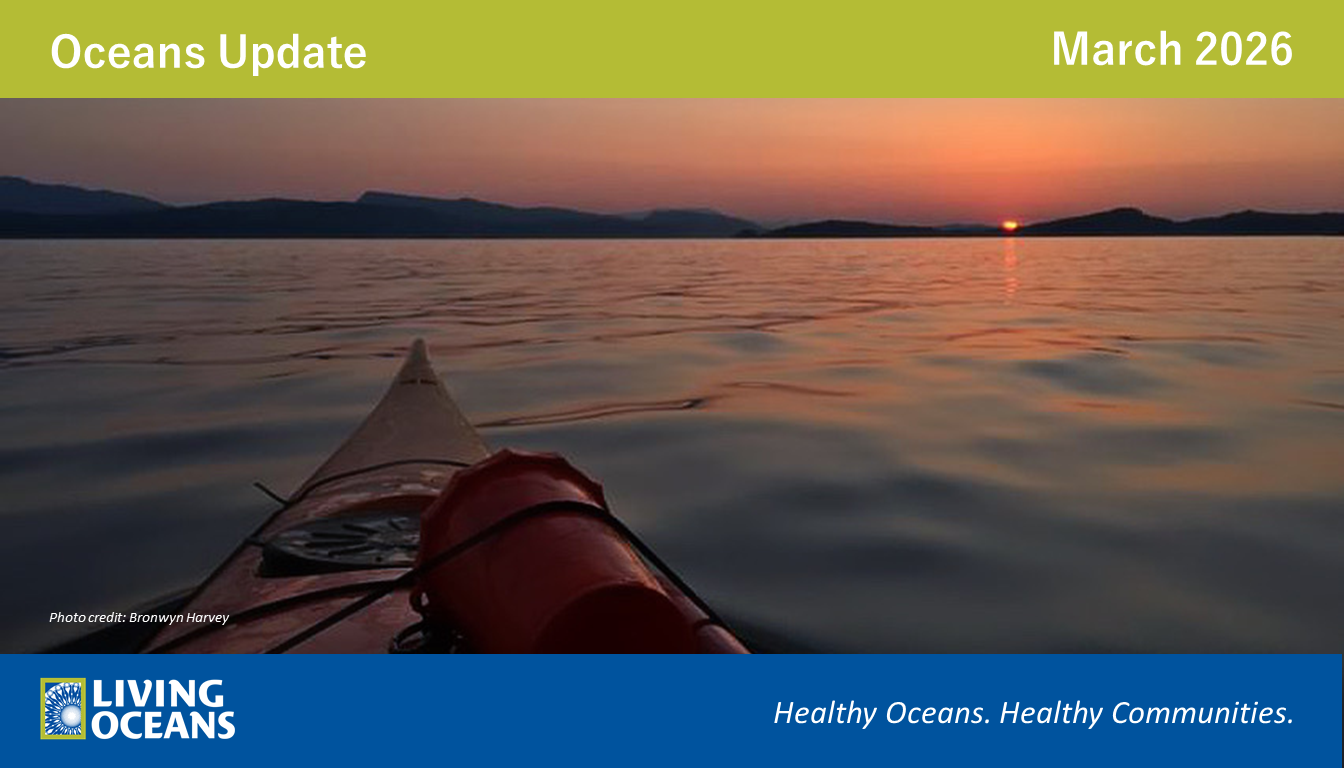
For over a decade, Living Oceans hasn’t missed a summer of field work. We’ve done at least one expedition, sometimes far more. We’ve picked up at least 130 metric tonnes of plastic debris, transported it, sorted it and left our amazing northern Vancouver Island beaches clear of harmful plastics. I know that our intrepid volunteers are as proud of that work as they are eager to do it again.
But this might be the year we have to sit it out. Can you help us with a donation today?
When the provincial government saw fit to provide funding equal to the challenge, we mobilized and recovered over 60 tonnes in a single year. There is far more plastic out there, but the government funding has been discontinued. Similarly, the foundations and corporations that have supported us in the past have moved on to new issues or grantees. Problems without permanent solutions within reach just aren’t as attractive to funders in the long haul. It really is work that our taxes or the plastics industry should be paying for, but they’re not.
And it seems every day I read another paper, finding micro- and nano-plastics in another living creature in the food web. The long-term implications of ingesting the chemicals contained in, and stuck to, marine plastics are as numerous as the chemicals themselves. In a biodiversity hotspot like the Scott Islands marine National Wildlife Area, the damage could be extend to seabirds, marine mammals, fish and terrestrial animals as well. Plastics have even been found in creatures as tiny as plankton, a fundamental part of the food web.
It’s galling to think we might have to take a pass on cleanup this year, but with your help, we might mount at least one expedition. Please take a moment to make a secure, online donation today!
And please, read on for updates on all of our campaigns including some very good news for wild salmon!
Discovery Islands stay salmon farm free: Federal Court of Appeal
.jpg)
Living Oceans greeted a January decision from the Federal Court of Appeal with gratitude and relief. The three appellate judges were unanimous in upholding a lower court ruling in a case brought by Norwegian salmon farm giant MOWI. The appeal decision effectively ends five years of litigation aimed at re-opening salmon farms in the Discovery Islands. We have always maintained that this region, together with the Broughton Archipelago, is critical to wild salmon survival and should never have seen industrial-scale farming.
The court rulings confirmed former Fisheries Minister Joyce Murray’s decision to keep salmon farms in the Discovery Islands shuttered. Farms have been closed there since early 2021, when licence extensions were first denied. Minister Murray made an express finding that science required that she make a precautionary decision about the licences and the Court’s decision confirms that choice. It also affirmed the Minister’s right to look beyond the advice being offered by her Department, which has long been criticized as a captive regulator.
Since farms have been removed from Sechelt, the Discovery Islands and the Broughton Archipelago, the Salmon Coast Field Station has reported healthier-looking juvenile salmon with fewer salmon lice each year. Returns of adult salmon have increased as well, with this year’s Fraser River sockeye returns outperforming the forecast by over 400 per cent. Broughton stocks of pink salmon have increased by orders of magnitude as well.
“We all owe a debt of gratitude to these Ministers who stood firm in showing the Department of Fisheries what precautionary decision-making looks like,” said Karen Wristen, Executive Director at Living Oceans Society. “Departmental advice was to re-issue the Discovery Islands licences but both Ministers took the time to hear from independent scientists who have published extensively on the harm caused by salmon farms.”
The government has promised to end open-net pen salmon farming across B.C. by 2029, but has yet to deliver the long-awaited Salmon Aquaculture Transition Plan or to define what technology will be permitted for use after the ban takes effect. Living Oceans continues to demand an end to ocean-based salmon farms—please join us by sending a letter to the Fisheries Minister today!
Photo credit: Tavish Campbell
DFO’s Genomics Lab on the Chopping Block

We often use this space to criticize “DFO” (the Department of Fisheries), but we’re generally referring to particular parts of that enormous bureaucracy that are actively damaging wild salmon populations. One part of DFO for which we’re eternally grateful is Dr. Kristi Miller-Saunders’ genomics lab. She has pioneered incredible tools that help pinpoint exactly what ails a fish and where it comes from. That’s how she knew that salmon farms presented a clear risk of disease transmission—a fact she bravely insisted on sharing with the scientific community and her bosses, despite all attempts to muzzle her.
Now, Dr. Miller-Saunders has retired, and the word is; her position is not going to be filled.
Scientists from around the world appreciate and continue to use the tools developed here in Canada but instead of rewarding the work, those other parts of DFO that we usually talk about are thinking they’ll defund it.
Read the letter to Minister of Fisheries Joanne Thompson, authored by Dr. Gideon Mordecai, University of British Columbia and signed by sixteen prominent fisheries scientists from across Canada, the U.S. and Norway [here].
Aquaculture’s role in the growing threat of antimicrobial resistance
.jpg)
Antimicrobial resistance (AMR) is often described as a “silent pandemic”. Unlike a fast-moving viral outbreak, AMR spreads gradually with bacteria evolving and adapting until the medicines we rely on no longer work. The consequences are profound. AMR contributed to an estimated 4.95 million deaths in 2019. These numbers are expected to increase to 8-10 million deaths by 2050. AMR now threatens routine surgery, cancer treatment, and infection control.
Human activities, including the widespread use and misuse of antibiotics in human medicine, livestock production, and aquaculture, have dramatically accelerated AMR. In response, the World Health Organisation (WHO) has established the One Health initiative — linking human health, animal production and environmental systems. Aquaculture sits squarely within that nexus.
Aquaculture, antibiotic use, and how AMR enters our food supply
As with any intensive animal production system, disease outbreaks can and do occur. Antimicrobials have therefore been used in aquaculture for treatment and, in some cases, for prevention.
What makes aquaculture distinct is its environmental interface. Aquaculture operations are often open or semi-open systems. When medicated feed is used, some antibiotics pass into surrounding waters and sediments. This creates ecological conditions where resistant bacteria and antimicrobial resistance genes can emerge and persist.
Research has shown that aquaculture environments can act as reservoirs and amplification points for resistance genes. But how does this connect to human health?
There are three main pathways by which AMR linked to aquaculture may reach seafood consumers:
-
Direct exposure to resistant bacteria: Farmed seafood can carry bacteria naturally present in aquatic environments, including species such as Vibrio, Aeromonas, and occasionally E. coli. If these bacteria are resistant to antibiotics, and if seafood is eaten raw or undercooked, humans may be directly exposed. Even when cooking kills bacteria, improper handling — such as cross-contamination in kitchens — can transfer resistant microbes to other foods.
-
Transfer of resistance genes in the gut: Resistance genes do not need to arrive in a fully pathogenic bacterium to pose a risk. Many bacteria exchange genetic material through horizontal gene transfer. If resistant bacteria from seafood enter the human gut, they may pass resistance genes to other bacteria, including opportunistic pathogens.
-
Antibiotic residues and selective pressure: Antibiotic residues in seafood products can contribute to low-level exposure in humans.
Together, these pathways illustrate why AMR in aquaculture is not confined to farm boundaries. It can move along supply chains and into human microbial ecosystems.
The most found farmed seafood in Canadian grocers are farmed salmon, both domestic and imported (e.g., Chile), and imported shrimp from various countries.
In Canada, salmon farming primarily uses the antibiotics oxytetracycline and florfenicol. These are considered ‘highly important’ antibiotics by the WHO. Highly important antibiotics are considered medically essential for treating serious human infections, with few or no other alternatives. On average, a B.C. salmon farm will use 1.3 antibiotics per year. Resistance genes associated with these antibiotic classes have been detected in sediments near B.C. and Atlantic farms.
Imported salmon from Chile has the highest antibiotics use of all salmon farming regions globally with approximately 351 tons used in 2024. This is mostly driven by the ‘highly important’ antibiotics, oxytetracycline, and florfenicol. Like Canada, resistant bacteria and resistance genes have been detected in farm environments and surrounding sediments.
Canada imports farmed shrimp from countries such as China, India, Vietnam, Thailand and Ecuador. Because shrimp are not widely vaccinated, bacterial disease has historically driven antibiotic use in some regions – particularly the recurrent use of oxytetracycline and florfenicol. Prohibited or off label use of fluoroquinolones has also been documented Similarly to salmon, studies show that antibiotics used in shrimp ponds can accumulate in sediments and that resistance genes are detectable in surrounding ecosystems.
Antimicrobial resistance is not solely a hospital problem. It is shaped by how we produce food — including seafood. AMR requires a commitment to antimicrobial stewardship across seafood supply chains – from producers to major retailers. That’s why Living Oceans has teamed up with McGill University’s Antimicrobial Resistance Centre and World Animal Protection on a study to find out the prevalence of AMR within farmed salmon and shrimp sold in Canadian retailers. Stay tuned!
Open Letter to Federal Parliamentarians to remove “Henry the VIII” exemption powers from Budget Bill C-15

Last month, Living Oceans and SeaChoice member groups joined 100+ prominent law and human rights experts, labour, sector leaders and civil society organizations warn the proposed amendments to the Red Tape Reduction Act in Bill C-15 set Canada on a dangerous anti-democratic track.
The letter (re-posted below) was organized by Ecojustice Canada, Canadian Civil Liberties Association Centre, and Québécois du droit de l'environnement.
Dear Members of Parliament:
The resilience of Canadian democracy and the rule of law is not unshakeable. It is fragile and precious, and it is arguably the most pivotal tool we can wield to protect ourselves and our communities when both our sovereignty and economy are under threat. Yet, Bill C-15, which the federal government has espoused as its answer to the economic attacks that Canada is facing, contains a major threat to the very constitutional underpinning that ensures a thriving democratic governance system.
Buried on page 300 of a more than 600-page long budget implementation bill is a constitutional abomination. Part 5, Division 5 of this bill introduces draconian powers that allow federal ministers to exempt any individual, company or government (including its own federal departments) from the application of any federal law or regulation. No legislation is safe, except for the Criminal Code. Not our labour standards. Not our health and safety regulations. Not laws that uphold Indigenous rights and sovereignty. Not environmental protection laws. And not even laws that protect our security and privacy.
These “Henry the VIII” powers — which refer to the ability of the executive (here, ministers) to unilaterally change an act of Parliament — are an affront to the separation of powers: the constitutional architecture that ensures a system where Parliament makes laws, the executive implements them, and the courts interpret them. This balance is a hallmark of a thriving Canadian democracy and one that will define how we as a country resist a troubling trend of democratic decline that we observe around the world.
As many legal experts asserted in testimonies and submissions in the Parliamentary and Senate committee hearings on Bill C-15, the proposed changes to the Red Tape Reduction Act cannot be characterized as “regulatory sandboxing.” They are in fact a dramatic departure from the common regulatory sandbox approach in Canadian law, which temporarily creates targeted, tightly controlled and highly transparent environments that enable the testing of new technologies to better understand their impacts — including how to regulate them. If passed, the amended Red Tape Reduction Act would introduce vague and overbroad notions like “competitiveness” and “economic growth” as legitimate reasons for exemptions from any Act of Parliament. Left for the interpretation of the minister that wants to wield them, these terms can mean anything.
These exemption powers do not streamline regulation — they dynamite the rule of law itself by creating a two-tier legislative system whereby laws debated and enacted by Parliament can be suspended for political convenience with little to no accountability or transparency.
We call on you to stand up for Canada’s democratic tradition and advocate for the removal of Part 5, Division 5 of Bill C-15. These powers, if passed, have the potential to undermine decades of law-making by Parliament and suspend laws that were intentionally designed by you and your colleagues — past and present — to protect our families, our public health, our security, the air that we breathe, our iconic endangered species, and issues that your constituents cherish. They will set Canada on the wrong path toward a weaker Parliamentary democracy, with potentially catastrophic implications.
We urge you to stand up for the Parliament and the people you serve. Stand up for the rule of law. Stand up for the constitutional order that can protect our democracy.
Remove Part 5, Division 5 from Bill C-15.
List of signatories:
Canadian Civil Liberties Association
CQDE – Centre québécois du droit de l’environnement
Ecojustice
David Asper Centre for Constitutional Rights
Canadian Labour Congress
Alex Neve, O.C., Senior Fellow, Graduate School of Public and International Affairs, University of Ottawa
Jennifer Quaid, Professeure titulaire, Section de droit civil, Université d’Ottawa
Human Rights Watch
Canadian Public Health Association
International Civil Liberties Monitoring Group
Iranian Canadian Legal Professionals (ICLP)
Democracy Watch
Jamie Cameron, Professor Emerita
James L Turk, Director, Centre for Free Expression
Penelope Simons, Professor, Common Law and Director of the Human Rights Research and Education Centre
Ladan Mehranvar, Senior Legal Researcher, Columbia Center on Sustainable Investment
Egale Canada
National Farmers Union
Arab Canadian Lawyers Association
Breast Cancer Action Quebec / Action cancer du sein du Québec
BC Freedom of Information and Privacy Association
West Coast Environmental Law Association
Dr. Angela Cameron, Associate Professor, Faculty of Law, University of Ottawa
Canadian Environmental Law Association
Équiterre
Alain Branchaud, Directeur général, SNAP Québec
East Coast Environmental Law
Grand Riverkeeper Labrador
Legal Advocates for Nature’s Defence
David Suzuki Foundation
Canadian Association of Physicians for the Environment – Ontario Committee
Environmental Defence Canada
Canadian Council for Refugees
Greenpeace Canada
Caroline Brouillette, Climate Action Network Canada
Nature Canada
Travailleuses et travailleurs pour la justice climatique / Workers for climate justice
Laurence Guénette, Ligue des droits et libertés
OpenMedia
Gavin Pitchford, CEO, Delta Management Group/Clean50
Front commun québécois pour une gestion écologique des déchets
Citizens’ Climate Lobby Canada
For Our Kids, Burnaby
Justice For Migrant Workers
Living Oceans Society
Tylene Appel and Alan Silverman, Seniors for Climate Action Now!
Climate Justice Saskatoon
Friends of the Earth Canada
Climate Legacy
Dr. Trevor Hancock, Emeritus Professor of Public Health and Social Policy, University of Victoria
Christopher Campbell-Duruflé, Assistant Professor, Lincoln Alexander School of Law, Toronto Metropolitan University
Gareth Gransaull, re•generation
Canadian Interfaith Fast For the Climate
Slovenian Home Association
Decolonial Solidarity
Mères au front
350 Canada
Calgary Climate Hub
The ENRICH Project
Above Ground (a project of MakeWay)
Prevent Cancer Now
Dr. Geoffrey Strong, Retired Atmospheric/Climate Scientist
Ecology Action Centre
Canadian Anti-Monopoly Project (CAMP)
Council of Canadians
Grandmothers Act to Save the Planet (GASP)
Second Wind Liberation
Leadnow
Daniel Mockle, Professeur de droit public, Faculté de Science politique et de Droit, Université du Québec à Montréal (UQAM)
Rebecca MacLeod, Executive Director, New Grocery Movement
Alliance 4 Democracy/Sunshine Coast Seniors for Climate Action Now
Climate Action for Lifelong Learners (CALL)
MiningWatch Canada
Canadian Association of Nurses for the Environment
Avalon/NL chapter, Council of Canadians
Lindsay McLaren, Professor, Department of Community Health Sciences, University of Calgary
Camille Fréchette, Lawyer
Environmental Justice & Sustainability Clinic, Osgoode Hall Law School
Fondation Rivières
Rébecca Pétrin, Directrice générale, Eau Secours
Citizens for Public Justice (CPJ)
SeaChoice
Teachers for Future Turtle Island
Touwendé Roland Ouedraogo, Chargé de cours à l’UQAM et à l’UdeM
BCTF Divest Now
Inter Pares
Stand.earth
Shift: Action for Pension Wealth & Planet Health (A project of Makeway)
Canadian Network on Corporate Accountability / Réseau canadien sur la reddition de compte des entreprises
Vigilance OGM
Canadian Health Association for Sustainability and Equity (CHASE)
Anne-Josée Laquerre, Directrice générale et co-initiatrice, Québec Net Positif
Touch Grass Club
Alexandre Lillo, Professeur – Département des sciences juridiques (UQÀM)
Elisabeth Patterson, avocate et associée, Dionne Schulze
Cédric Gagnon-Ducharme, Avocat
Dr. Alexandra Pedersen, Adjunct Assistant Professor, Queen’s University
Manitoba Eco-Network Inc.
Zero Waste BC
Kate Petriw, Communications and Narratives Co-Lead, Wellbeing Economy Alliance (Canada)
Chief Allan Adam, Athabasca Chipewyan First Nation
Seniors For Climate
Environmental Law Centre (Alberta) Society
Pacific Salmon: Treaty or War?
.jpg)
As if we didn’t have enough to worry about on the Canada: US front, the treaty that governs how we share fishing rights with the US is up for renegotiation. Pacific Salmon Commissioners from three US states and Canada met in February in Vancouver to begin the negotiations.
The years when we didn’t have the treaty weren’t good news for wild salmon. Whether it was Alaskan fishers scooping Fraser salmon, or Canadian fishers trying to ensure they got every last fish before they crossed the southern border, it was the salmon that paid the price.
The Pacific Salmon Treaty was first signed in 1985, enshrining the principle that each country should participate in the fishery in proportion to the production of fish from its rivers. But in 1992, the agreement broke down. The period from then until the Treaty was revived in 1999 was known as the Salmon Wars. Fishermen everywhere were engaging in acts of protest, blockading vessels of the other side. The government weighed in with a steep ‘transit fee’ and new regulations imposed on US vessels using the inside waters to get to the Alaskan fishing grounds.
The Salmon Wars marked the beginning of a steep decline in Fraser salmon, to historically low levels.
From 1999 to the present, the Treaty has been renewed in 10-year intervals, the next of which will begin in 2028. It is vitally important to the recovery of threatened and endangered salmon populations that the Treaty should be renewed. Funding for the recovery and monitoring of the Fraser’s wild salmon is no doubt assigned to support Treaty commitments.
Pipeline or Posturing?

Living Oceans worked for a decade to prevent a northern tar sands pipeline and secure legislation to enshrine the northern waters tanker ban in law. The ink is barely dry on that legislation and our new Prime Minister has already agreed to suspend its operation should Alberta Premier Danielle Smith succeed in her bid to have another pipeline built to the northern B.C. coast.
There are so many caveats to the ‘agreement’ with Alberta that we’re not really sure we need to dust off the old files.
First, it requires the consent of First Nations whose territories this pipeline would cross. Coastal First Nations have been clear: consent will not be forthcoming. Premier Smith has accordingly set her sights on ‘another route’, presumably to Prince Rupert. She’s offering up to a fifty per cent stake in the pipeline, presumably shared among the dozen or so Nations whose territory would be involved (the actual route isn’t known). Meaning there’s only another fifty per cent left for any investor.
Second, there’s no agreement to fund the pipeline (thanks very much; one was more than enough). Private investment would have to be found. Enbridge has already said ‘no’. Kinder Morgan is unlikely to want to go another round with protests and litigation. TC Energy likely feels the same after Energy East. All three companies sank millions of dollars into a process that did not result in them building pipelines.
Finally, while the ‘agreement’ provides for a streamlined federal approval process, there’s nothing in it for British Columbia but risk and Premier Eby isn’t happy about that. The provincial environmental approval process could bog down that ambitious 2-year approval goal set by Carney and Smith.
Factor in the underutilized TransMountain pipeline, the economic uncertainty caused by U.S. tariffs, the increasing appreciation in financial markets of the climate risk involved in unbridled fossil fuel development…we’re thinking we can sit this one out.
This brings us to the question, is Danielle Smith really bidding to have another pipeline built, or betting that the ‘agreement’ will stave off a positive referendum vote on Alberta separation? If this unprecedented, apparent federal-provincial co-operation helps the Premier through an awkward political moment and relieves Prime Minister Carney of the burden of negotiating Alberta out of Confederation, they both win. If some fool steps up to build the pipeline, however, we all lose.
La reddition de compte des entreprises sur une base volontaire ne suffit pas. Le Canada doit la rendre obligatoire.
.jpg)
Par Kelly Roebuck et Georgina Alonso
Le gouvernement fédéral ne prend pas les mesures nécessaires pour tenir les entreprises responsables des violations des droits humains et de l’environnement qui les impliquent. Il s’attend à ce que les entreprises agissent volontairement en fonction de simples attentes et encouragements.
Il s’agit d’un problème important et répandu. Parmi les 200 entités économiques aux revenus les plus élevés, 157 sont des entreprises, et non des pays. Certaines de ces entreprises commettent des actes néfastes, comme polluer ou vider les réserves d’eau, émettre des gaz à effet de serre et outrepasser les droits des peuples autochtones.
Pourtant, les entreprises doivent choisir elles-mêmes les normes internationales sur la responsabilité sociale des entreprises qu’elles mettent en œuvre, et ce, sur une base volontaire, comme les cibles d’émission, les codes de conduite, les politiques d’approvisionnement éthique et les certifications pertinentes, si seulement elles décident de le faire.
Le Canada doit se munir de lois solides qui obligent les entreprises à prévenir toute violation des droits humains et de l’environnement liée à l’exercice de leurs activités et à leur chaîne d’approvisionnement, de même qu’à offrir des recours en cas de préjudice.
Le gouvernement sortant a reconnu le caractère inadéquat des lois existantes en matière de reddition de compte des entreprises. Le gouvernement actuel n’a toujours pas mentionné de plan visant à résoudre ce problème. Il est grand temps qu’Ottawa agisse comme il se doit.
Des politiques souvent ignorées
Par exemple, certains aspects de l’industrie des produits de la mer, qui implique la protéine animale la plus commercialisée au monde, sont associés à des violations importantes des droits humains et de l’environnement, notamment la surpêche, la pêche illégale, la dégradation des écosystèmes marins ainsi que le travail forcé et d’autres conditions de travail inhumaines.
Une série d’enquêtes a dévoilé que ces violations demeurent répandues au sein des chaînes d’approvisionnement de produits de la mer, y compris celles liées aux détaillants canadiens, malgré la mise en œuvre volontaire par tous les détaillants de politiques sur les produits de la mer durables.
Ces politiques présentent de graves lacunes. Selon un rapport publié récemment par SeaChoice, un groupe de vigilance sur la durabilité des produits de la mer, les politiques en matière de droits humains des détaillants ne sont souvent pas intégrées dans les pratiques opérationnelles. Qui plus est, aucun détaillant canadien ne vérifie si les marques tierces respectent les politiques de l’entreprise.
Même les politiques les plus rigoureuses en matière de produits de la mer durables ne sont appliquées qu’en surface. Elles ne concernent souvent qu’environ la moitié des produits sur les tablettes. Dans certains cas, la portée des politiques se limite à une portion des succursales de détail d’une même entreprise.
Pire encore, cet enjeu ne touche pas que les produits de la mer. Les violations des droits humains et de l’environnement continuent d’abonder dans plusieurs secteurs, y compris les hydrocarbures, la foresterie, l’exploitation minière, l’industrie textile, le cacao et le soya, au sein desquels les politiques, les certifications et les audits ne sont appliqués d’ordinaire que sur une base volontaire.
Les preuves sont sans équivoques : les mesures prises sur une base volontaire ne sont tout simplement pas efficaces. Cela n’a pas empêché le gouvernement fédéral de s’y fier dans ses efforts de prévention des violations liées à des entreprises canadiennes.
Le gouvernement libéral sortant a reconnu « qu’il faut en faire plus » pour lutter contre les abus des entreprises. Il avait même annoncé en décembre dernier son intention de présenter un projet de loi visant à mettre en œuvre un régime de diligence raisonnable en matière de droits fondamentaux du travail liés aux chaînes d’approvisionnement. Cette mesure législative n’a toutefois pas été présentée avant la dissolution du Parlement dans le cadre des élections d’avril.
Le nouveau gouvernement n’a toujours pas démontré son intention de donner suite à cette proposition déjà limitée; il a plutôt préféré encourager la croissance du secteur privé pour tenter de remédier au problème.
Cette initiative ne risque pas d’aider le Canada à respecter ses engagements internationaux, notamment l’Accord de Paris sur les changements climatiques, le Cadre mondial de la biodiversité de Kunming à Montréal, qui vise à stopper et inverser le processus de perte de biodiversité, et les objectifs de développement durable des Nations Unies, qui concernent la lutte contre la pauvreté et les inégalités ainsi que la protection de la planète d’ici 2030.
Le respect de ces engagements dépend de la capacité des pays les plus prospères et les plus pollueurs, y compris le Canada, à tenir les entreprises responsables de leurs actes.
Il faut agir maintenant
Le Canada doit adopter une nouvelle loi qui régit la reddition de compte des entreprises afin d’obliger ses entreprises à prévenir les violations des droits humains et de l’environnement à toutes les étapes de la chaîne d’approvisionnement.
Plus de 50 000 Canadiens et Canadiennes ont demandé à Ottawa d’adopter une telle loi. D’autres pays, dont plusieurs des plus importants partenaires commerciaux du Canada, en ont adopté une ou prévoient de le faire.
Le Réseau canadien sur la reddition de compte des entreprises a élaboré un modèle législatif approuvé par plus de 200 organisations au Canada et à l’étranger, sur lequel le Canada peut se fier.
L’adoption d’une loi pertinente en matière de reddition de compte des entreprises est essentielle au respect de nos engagements internationaux concernant les droits humains et de l’environnement. Ouvrons la voie à un avenir juste. Le manque de responsabilisation des entreprises met cet avenir entre les mains des gens pour qui le profit passe avant la population et la planète.
***************************************
Kelly Roebuck est directrice de la campagne sur les produits de la mer durables et représentante de Living Oceans dans le cadre du programme SeaChoice. Elle travaille principalement sur la reddition de compte des entreprises qui font partie des chaînes d’approvisionnement de produits de la mer, sur l’écoétiquetage et sur l’écoblanchiment.
Georgina Alonso est l’agente principale de la recherche et de la sensibilisation d’Above Ground, un projet qui touche les droits humains et la reddition de compte des entreprises. Elle est titulaire d’un doctorat en développement international de l’Université d’Ottawa.
You are what you eat!
 (1).png)
There is no place for open-net pen farmed salmon on a truly sustainable menu — not in restaurants, not in markets, not at home.
Open-net salmon farms pollute coastal waters on both the west and east coasts of Canada and around the world. Despite industry greenwashing, these operations release viruses, bacteria, and parasites that can infect wild salmon — especially vulnerable juveniles migrating to sea.
They also rely on massive quantities of wild forage fish like herring, mackerel, sardines, and anchovies for feed — putting additional pressure on ocean ecosystems.
And farmed salmon are not equivalent to wild. Studies show they can contain more Omega-6 and less Omega-3, less protein, antibiotics, and in some cases higher levels of contaminants such as PCBs.
This is not sustainable. It’s not healthy. And it’s not acceptable.
Momentum is building. Chefs and businesses across the country are stepping up and committing to keep open-net pen farmed salmon #OffTheTable.
Now we need you. Take open-net pen farmed salmon #OffTheTable — NOW.
- Visit offthetable.ca
- Encourage your favourite chef or restaurant to join
- Ask your waiter where the salmon on the menu comes from
- Tag @livingoceans and @ASFSalmon on social media to help grow the movement
Together, we can shift the market — and protect wild salmon for good.
New Report Challenges the Promise of Sustainable Fish Farming
.png)
For years, industrial farmed salmon has been sold as a solution to save wild stocks and a climate-friendly protein to feed a growing global population. But a new report from the Aquaculture Accountability Project is challenging these industry narratives.
The report, The Myth of “Sustainable” Aquaculture, uncovers the reality: rather than relieving pressure on oceans, industrial fish farming has effectively brought factory farming into marine ecosystems—with many of the same environmental, climate, and public health consequences.
The report cites many of our Living Oceans and SeaChoice reports from over the years that have demonstrated time and time again that farmed salmon certifications’ weak environmental standards enable the industry to greenwash itself as ‘responsible’ and ‘sustainable’.
Myth-busting takeaways from the report include:
#1 Farmed fish still depend heavily on wild fish: One of the farmed salmon industry’s central claims is that farming fish reduces overfishing. In reality, many farmed species—especially salmon—depend on feed made from wild-caught fish. This creates what the report describes as a fundamental inefficiency: instead of adding to the global food supply, industrial aquaculture can result in a net loss of marine protein while continuing to put pressure on wild ecosystems.
#2 Aquaculture didn’t just respond to demand—it helped create it: Aquaculture is often framed as a response to growing global demand for seafood. But the report argues the industry has also actively shaped that demand. Through marketing and policy influence, foods that were once occasional luxuries—like salmon—have become everyday staples in wealthier countries. This expansion has locked in higher consumption levels, driving both more fishing and more farming, while reinforcing the idea that continued growth is necessary and inevitable.
#3 Factory farming conditions in the ocean: The report also highlights the realities of industrial fish farming itself. Fish and shrimp are often raised in crowded pens or ponds, where disease can spread quickly. To keep production viable, producers frequently rely on antibiotics and other chemicals. This raises broader concerns about antimicrobial resistance, a growing global public health threat. Some studies have found high rates of antibiotic residues in farmed seafood, raising questions about oversight and food safety.
#4 Not as climate-friendly as advertised: Seafood is often promoted as a climate-friendly alternative to land-based meat. But the report argues that when the full lifecycle is considered—including feed production, habitat destruction, transportation —the climate footprint of farmed seafood can be significant.
#5 Eco-labels act as greenwash, not assurances of sustainability: Certifications are now commonplace on farmed salmon and other farmed seafood. But the report questions whether these systems provide meaningful accountability. It argues that weak standards, limited audits, and industry funding can allow environmentally harmful practices to continue under the banner of sustainability.
Hey Canada: It's time to ratify the High Seas Treaty
.png)
The High Seas Treaty reached a global milestone on September 19, 2025. It reached its crucial benchmark: 60 state ratifications. This achievement triggered a 120-day countdown to the Treaty’s entry into force, paving the way for a legally binding agreement that will strengthen global ocean protection, support climate resilience, and safeguard the livelihoods of billions. The High Seas Treaty officially entered into force on January 17, 2026, becoming legally binding international law and marking a historic moment for ocean protection.
Canada took an important step toward safeguarding biodiversity in international waters when it signed the Treaty on March 4, 2024. But signing alone is not enough. Until Canada completes full ratification, the Treaty cannot become law here, and its powerful conservation tools remain out of reach. Without ratification, Canada is unable to play a meaningful role in implementing measures to protect marine life beyond national borders — including identifying and supporting protected areas in high seas regions adjacent to Canadian waters or properly assessing and managing industrial activities proposed in neighbouring international waters. In short, until ratification happens, Canada’s commitment to protecting the high seas remains incomplete.
Canada needs to finish the job. Tell the government that we need to join this global community to protect our shared ocean, mitigate climate breakdown and safeguard the lives and livelihoods of billions of people.
Urge Canada to ratify the High Seas Treaty today.
It’s not just an empty, it's an opportunity

You can now support ocean conservation simply by returning your empty beverage containers! Through Return-It Express, your refunds can be donated directly to Living Oceans Society—no sorting, counting, or extra steps.
How it works:
1. Create a free Express account
Download the Return-It app, sign up, and search for Living Oceans Society. Set us as your preferred donation recipient, and your refunds will be sent automatically every time you drop off containers.
2. Bag your empties
Use sealed, clear plastic bags (up to 90L) and fill them with your refundable beverage containers.
3. Drop off at any Express location
Bring up to six bags per visit and use the Express kiosk—no need to wait in line.
4. That’s it!
Once counted, your refund is automatically donated to Living Oceans Society, helping fuel our work to protect Canada’s oceans and coastlines.
Turn your bottles and cans into real ocean impact.
Find your nearest Express location and start donating today!
Take action to keep Canada’s greenwashing rules
.png)
In 2024, Canada adopted new rules to combat misleading and false environmental claims. Fossil fuel lobbyists fought back hard against these rules. Fast forward to 2026, and the federal government is now on the cusp of rolling back the rules.
SeaChoice engaged in the consultation of new greenwashing rules. While not perfect, the rules set expectations for corporations that green claims must be backed up. Moreover, civil society was provided with the ability to bring concerns about unsubstantiated green claims to the Competition Tribunal. Under the rollbacks, this ability is removed.
Canada should be strengthening, not removing, its greenwashing rules. Send a message to the Prime Minister.
What We're Into March 2026
.jpg)
A lyrical informational picture book about how open-net pen fish farms impact wild salmon and their ecosystems. You can order the book from your local bookstore or visit Massy Books.
Order link A Salmon Story by Willie Poll, Chantelle Trainor-Matties, Tanina Williams | Massy Books
-
Ocean Equity Index
Free and easy to use, this assessment tool is designed to be accessible to a wide range of stakeholders: local communities, Indigenous peoples, NGOs, scientists, industries, and governments.
CBC podcast that explores the changing climate with host Laura Lynch and a team of journalists. They find inspiration in unexpected places, scrutinize new technologies and hold powerful people accountable.
High Seas Alliance has launched a new webinar series that aims to create a collaborative and accessible platform for sharing knowledge, building capacity, and fostering expertise across the diverse community working to implement the Treaty.
Appuyez Living Oceans

Votre appui nous permettra de convertir les élevages de saumon en systèmes à circuit fermé, garder nos côtes libres de pétroliers et finalement protéger nos trésors nationaux que sont nos régions côtières.
Pour en savoir davantage sur nos Océans
Abonnez-vous et soyez les premiers à recevoir de l'information sur nos campagnes et sur les problèmes qui affectent nos océans et les communautés vivant sur les côtes. Recevez aussi les "Alertes à l'action" pour pouvoir vous impliquez encore plus. Consultez notre politique de confidentialité.